Boat maintenance checklist for Dubai owners
What to look at before and after every trip, what to book by hours or by date, and a log sheet so nothing depends on memory.

On this page
The short answer
Routine boat maintenance comes in three layers: quick checks around every trip, service jobs that your engine and equipment manuals set by running hours or by date, and work that has to wait until the boat is out of the water. Owners and crew can handle most of the first layer without tools. The second and third belong to a technician. The full checklist at the end of this guide sorts every task that way, and the maintenance log records what was found and when the next job is due.
Dubai is hard on boats. Seawater in the Gulf passes 30°C in summer, which speeds up marine growth on the hull and inside cooling systems, and engine rooms and A/C plants work harder in the heat. None of that changes what's on the list. It changes how often you'll find something when you look.
01Before you leave the berth
Once you know where everything is, the pre-trip round takes about ten minutes. You're looking for change: an oil level that has dropped since last week, a strainer basket half full of weed, a bilge that's wetter than usual. A drop of oil under one engine means little on its own. The same drop getting bigger every week means a leak.
Start the engines and look over the stern. Each exhaust should push out cooling water with the exhaust gas. If one is dry or weak, shut that engine down. The usual causes are a closed seacock, a blocked strainer or a worn impeller, and running on without cooling water can destroy the impeller and overheat the exhaust hose. The air-conditioning works the same way: every unit has its own outlet on the side of the hull, and a unit that isn't pumping water will soon trip on high pressure.
If something looks wrong and you aren't sure what it is, stay on the berth. Take a photo or a short video and send it to us on WhatsApp. A picture of a weeping hose clamp is often enough to tell whether it can wait.
02After the trip: rinse, note, report
Salt left to dry on stainless steel, canvas and window seals holds moisture against them, and in summer it dries within minutes. A fresh-water rinse of everything above the waterline is the cheapest maintenance there is. Rinse teak gently; it doesn't need a pressure washer.
Then write two things in the log: the engine hours, and anything that was different. A new vibration at a certain rpm, a smell of hot rubber, a breaker that tripped twice. A note made on the day is worth far more to a technician than a description from memory three weeks later.
If your outboards or engines have a fresh-water flushing connection, use it the way the manual describes. Engines aren't all flushed the same way, so check before you connect a hose.
03Scheduled work, system by system
The technician jobs on the checklist are timed by the manual for each piece of equipment, by its condition, or by both. Here is what each system needs and where to get help with it.
Engines, gearboxes and generators
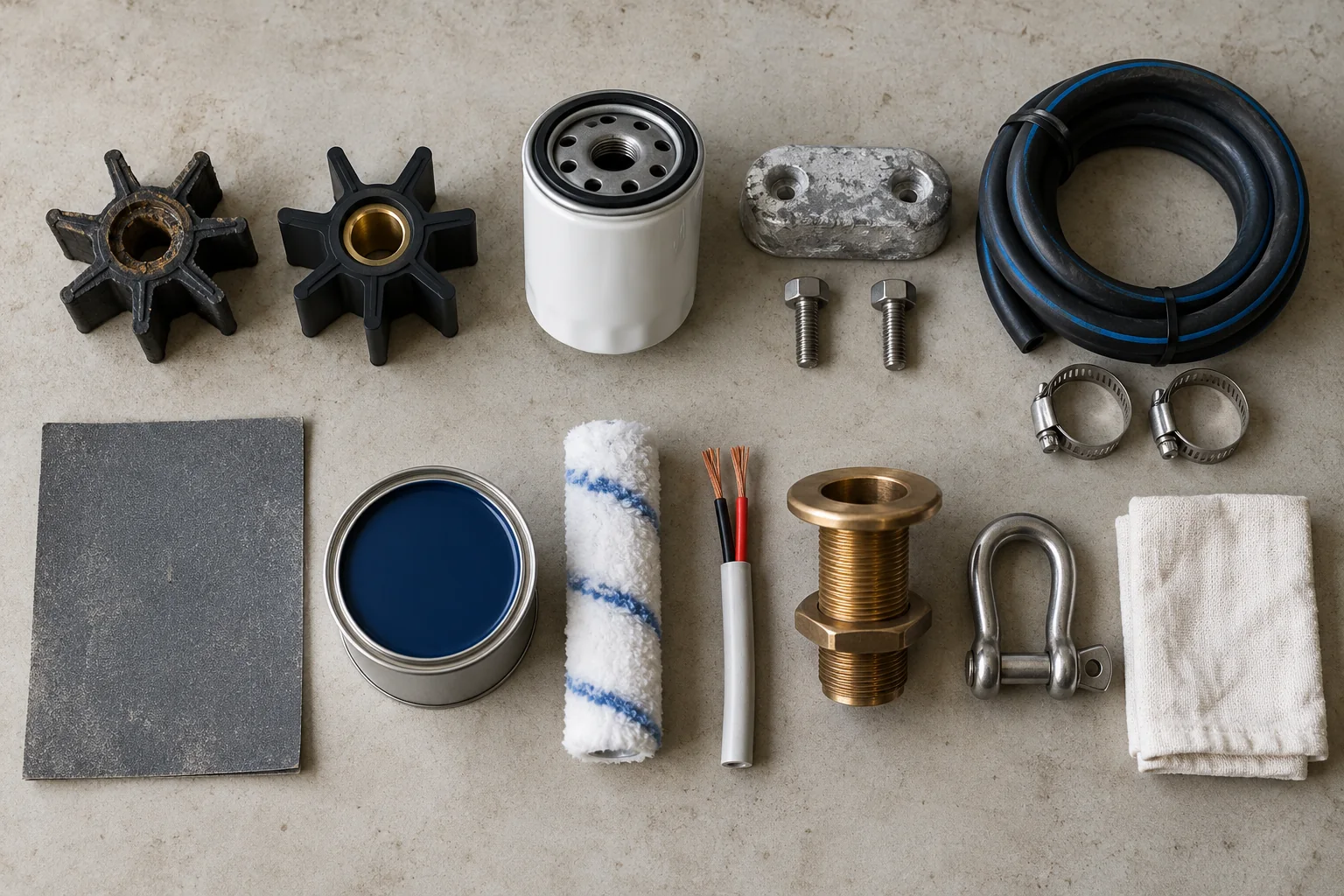
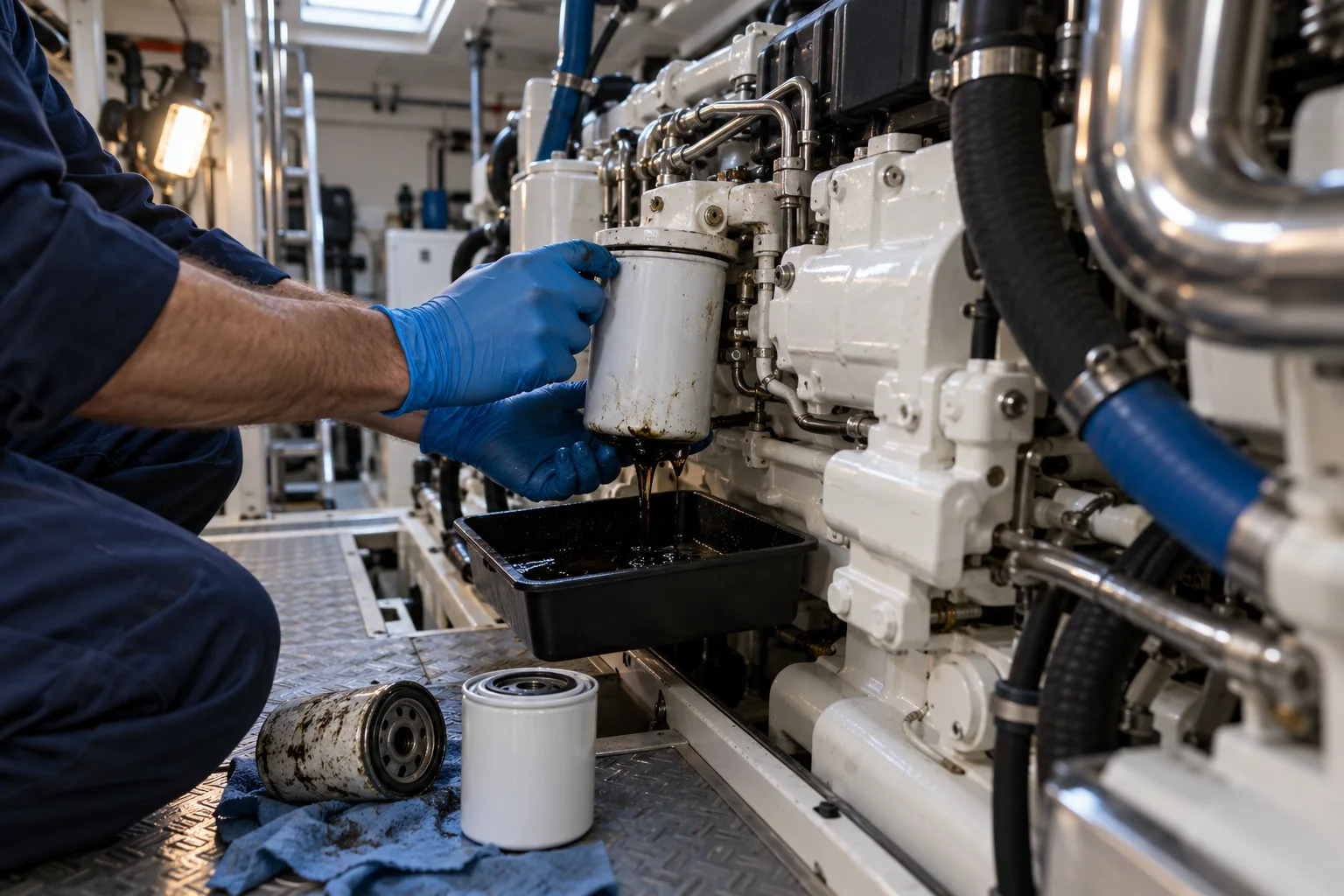
Engine manuals give most service items two limits: running hours and time. Whichever is reached first sets the due date. A boat that sits for most of the week reaches the time limit long before the hour limit, so it still needs its oil, filters and impeller changed. Our guide to engine service by hours or by calendar explains how to read the schedule. Generators have a schedule and an hour meter of their own. Our mechanics service marine engines and generators from Volvo Penta, Yanmar, Caterpillar, MTU, Cummins and MAN.
Electrical systems
Heat, salt and vibration work on every connection on board. Look for green or white crust on battery terminals and for loose cable lugs. Check the shore-power plug and the boat's inlet each time you connect. If either is warm, brown or melted at the pins, stop using that cable and have the plug, inlet and wiring checked. That's a fire risk. Batteries should be load-tested before summer. Marine electrical work covers fault-finding, shore power, chargers and battery banks.
Air-conditioning
In a Dubai summer the A/C runs for hours on end, pulling seawater through its own strainer, pump and condenser. Growth in any of them cuts the cooling. Owners can wash the return-air filters and check the strainer; refrigerant pressures, pumps and condensers belong to a technician. Book an A/C service in spring, so any fault turns up before the heat does.
Plumbing and bilge
Failed hoses and clamps below the waterline are a common reason boats sink at their berths, so check them on the monthly round: rust stains under a clamp, a hose that's soft or cracked, a damp patch that wasn't there before. Lift each bilge pump's float switch by hand and make sure the pump runs. A pump that runs often is telling you water is getting in somewhere. Our marine plumbing team traces leaks and replaces hoses, pumps and holding-tank systems.
Hull, antifouling and running gear
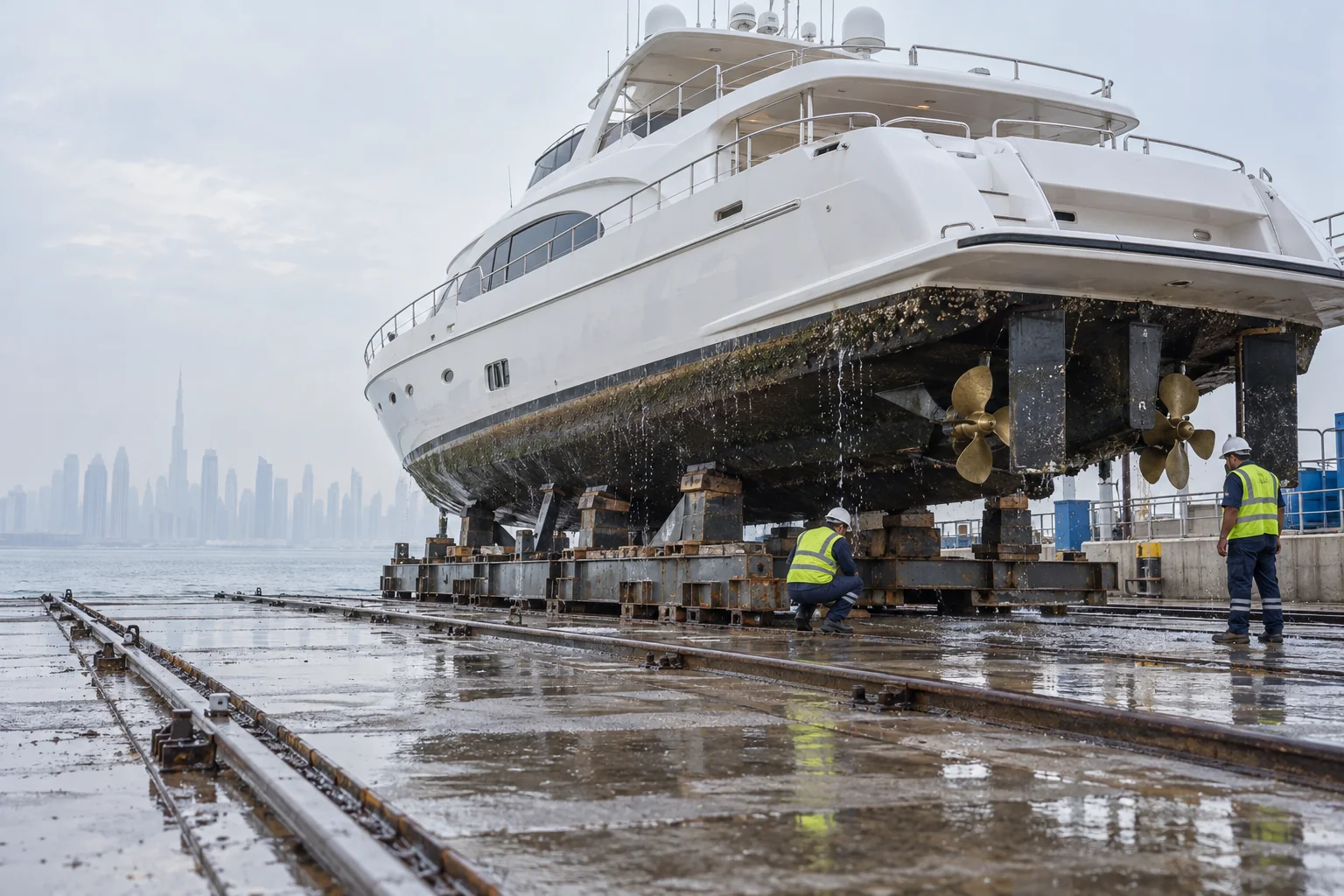
Warm water grows weed and barnacles fast, and a boat that rarely moves fouls faster than one in regular use. How long antifouling lasts depends on the product, the number of coats and how the boat is used, so it's a judgement made at each haul-out. Propellers, shafts, rudders and hull anodes are inspected at the same time; most anode makers say to replace an anode once about half of it has gone. Antifouling and hull finishing and the haul-out itself are usually planned together.
Fiberglass and gelcoat
Gelcoat that turns chalky has oxidised. Washing won't bring it back; it needs machine polishing. Spider cracks around stanchion bases, cleats and hatch corners show where the deck flexes or a fitting has worked loose. Impact damage near the waterline should be looked at quickly, before water gets into the laminate. Send photos and we can tell you whether it needs fiberglass or gelcoat repair.
Teak and carpentry
Clean teak with fresh water and a soft brush worked across the grain. Scrubbing along the grain, or using a pressure washer, strips the soft wood between the hard grain lines and wears the deck away. Watch for caulking that has lifted or shrunk out of the seams and for planks that move under your feet. Teak deck and carpentry repairs include re-caulking, plank replacement and new decks.
Interior and upholstery
A boat shut up in summer gets hot and humid inside, which is how mildew starts. Open it up whenever you're aboard, wipe away condensation and keep covers on cushions that live in the sun. Faded fabric, split seams and damp foam mean upholstery work is due.
Safety equipment
Read the dates: extinguisher service tags, flare expiry dates, liferaft and EPIRB service labels, and the gas cylinders in automatic lifejackets. What you must carry depends on the boat and its licence, so check with the authority that licenses your boat and follow each maker's service schedule. We supply and inspect marine safety equipment.
Name lettering, if fitted
Illuminated letters on the transom live in sun and spray. Check that every letter lights, that the fixings are tight and that no water has got inside. Our signage team can repair or replace letters that have come loose or gone dark.
04What to save for the haul-out
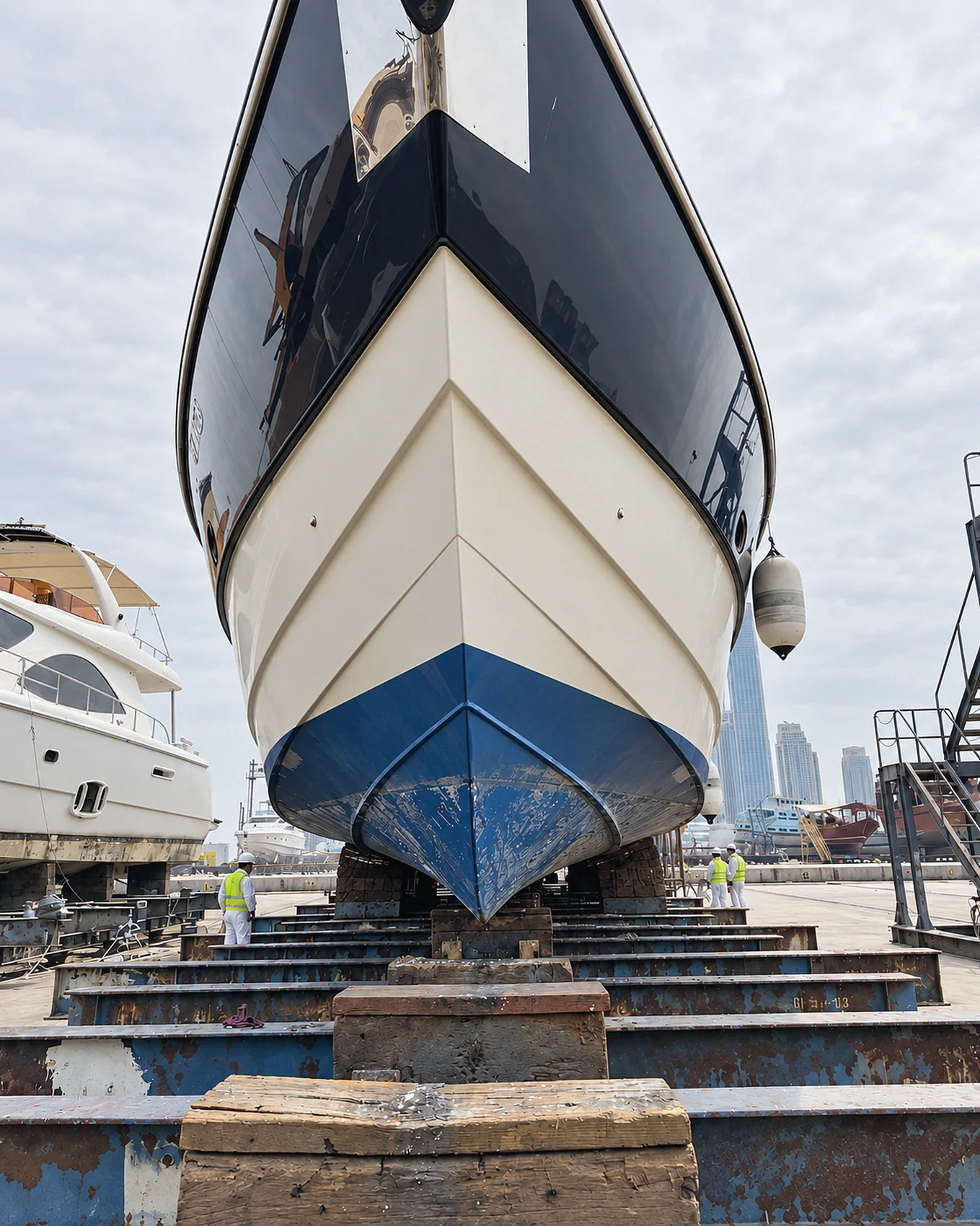
Some jobs can only be done with the boat out of the water. Others are simply easier then. Plan them together and you pay for one lift.
| Job | Why it waits for the haul-out |
|---|---|
| Antifouling | The hull has to be washed, dry and prepared before new coats go on. |
| Propellers, shafts and cutless bearings | Shaft play and blade damage can only be checked properly from below. |
| Hull anodes | They sit under water the rest of the time. Replace once about half has gone. |
| Through-hulls and seacocks | Fittings can be removed and replaced safely only when the boat is out. |
| Rudders and steering below the waterline | Bearings and play are checked from underneath. |
| Gelcoat and blisters below the waterline | Damage shows only once the hull is clean and dry. |
Every trade we use is in-house, so one haul-out at Dubai Maritime City can cover the list above along with engine, A/C and deck work. If it's your first time, read how to prepare for a haul-out before you book.
05Keep a maintenance log
A checklist tells you what to look at. A log tells you what you found last time, and that's what makes the next decision easy. Record the date, the engine hours, what you saw, what was done, who did it and when it's next due, by date and by hours. Keep the sheet on board in a plastic sleeve, and photograph each finished page so a wet log doesn't cost you the history.
Print as many pages as you need. One line per observation or job.
Maintenance log
| Date | Engine hours | What was seen | What was done | By | Next due (date / hours) |
|---|---|---|---|---|---|
| Example entry | |||||
| 14 Sep | 1,212 | Port exhaust weaker than starboard at idle | Raw-water strainer cleared; flow normal | Captain | Check impeller at next service |
When you send the boat in for service, send the log with it. It shortens the diagnosis, and diagnosis time is part of the bill.
06Common questions
What does routine boat maintenance include?
Regular checks of oil, coolant, cooling water, bilges, batteries and safety gear; engine and generator servicing by hours or date; A/C, electrical and plumbing checks; and hull work such as antifouling and anodes at a haul-out, which in Dubai is usually once a year.
How often does a boat need servicing?
Follow the engine manual and service at the hour limit or the time limit, whichever comes first. For most boats that means at least one full service a year, plus a haul-out for antifouling and an underwater inspection. Busy charter boats need it more often.
What can a new owner check without tools?
Oil and coolant levels, raw-water strainers, cooling water from each exhaust and A/C outlet, the bilge, battery charge, lights, horn, VHF and the dates on safety equipment. If anything changes from one trip to the next, write it down and ask a technician.
My boat hardly gets used. Does it still need maintenance?
Yes. Oil, coolant, impellers and seals age with time as well as use, batteries go flat, and a hull sitting still in warm water fouls faster than one that moves. Low-use boats are usually serviced by the calendar.
Can you put together a maintenance plan for my boat?
Yes. Send us the boat's make and length, the engines and their hours, and when it was last serviced and antifouled. We can plan the year with you, or set it up as an annual maintenance contract.
07The full checklist
Print it, keep it on board and tick it as you go. Owner tasks need eyes, ears and a torch. Technician tasks mean opening a system up, and should be done by someone who works on that equipment and has its manual.
38 items
Boat maintenance checklist
Before each trip09
- Owner
- Owner
- Owner
- Owner
- Owner
- Owner
- Owner
- Owner
- Owner
After each trip05
- Owner
- Owner
- Owner
- Owner
- Owner
Every month08
- Owner
- Owner
- Owner
- Owner
- Owner
- Owner
- Owner
- Owner
By engine hours or date10
- Technician
- Technician
- Technician
- Technician
- Technician
- Technician
- Technician
- Technician
- Technician
- Technician
At each haul-out06
- Technician
- Technician
- Technician
- Technician
- Technician
- Technician
Ticks are saved in this browser only.